
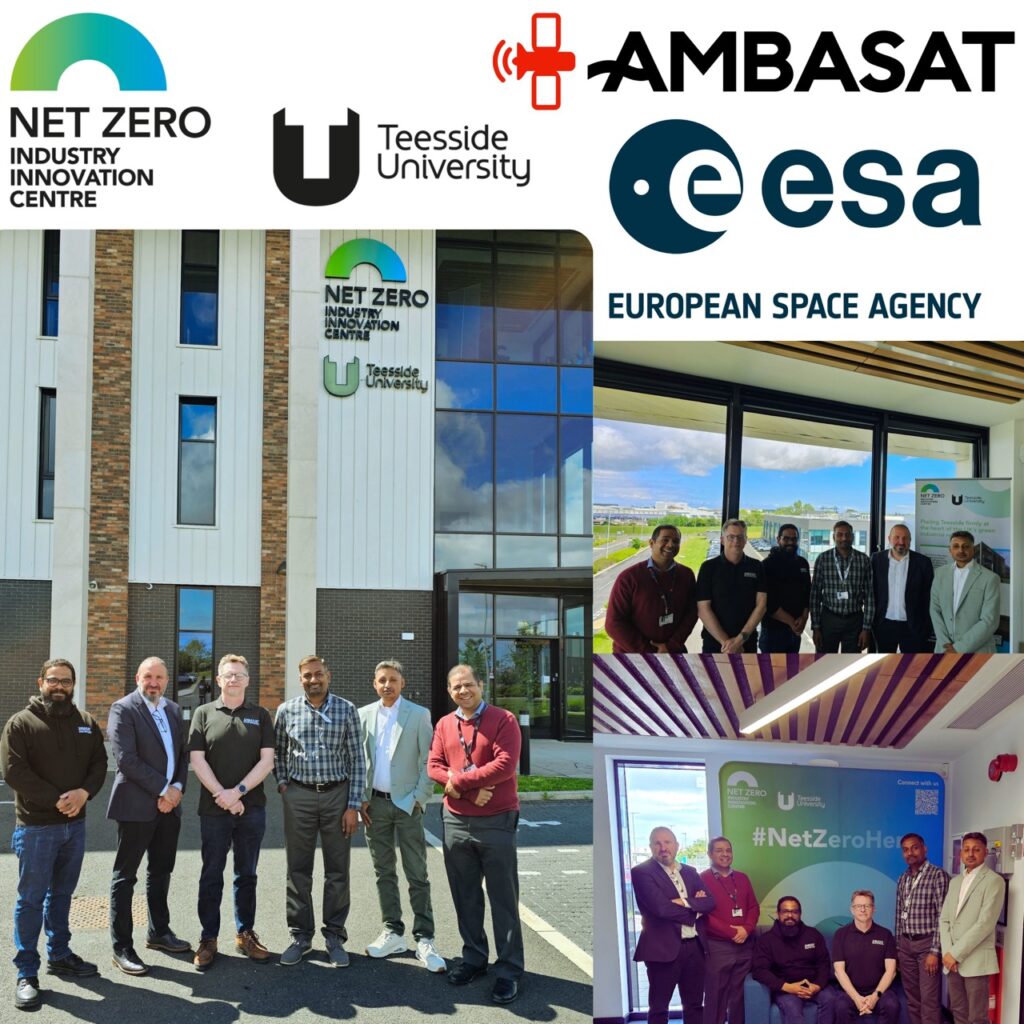
Main picture, left to right: Khurram Hussain (AmbaSat), Professor Ruben Pinedo-Cuenca (Teesside University – TU), Martin Platt (AmbaSat), Professor Kumar Patchigolla (TU), Dr. Shadab Alam (TU), Dr. Atma Prakash (TU).
AmbaSat and Teesside University are undertaking an ESA-supported feasibility study into satellite-enabled hydrogen monitoring for industrial applications.
The study will examine how ground-based sensing, resilient communications and cloud-based reporting could be combined into a practical service to support the safe expansion of green hydrogen infrastructure.
As hydrogen production, storage and distribution projects move from concept to deployment, operators face growing pressure to demonstrate safe operation, reliable monitoring and clear reporting. These challenges are particularly relevant at larger sites, remote locations and multi-site operations, where conventional fixed-point approaches may not always provide the full operational picture.
The ESA-funded activity will assess a service concept that brings together Teesside University’s Raman LIDAR research with AmbaSat’s remote monitoring, communications and reporting platform. The aim is not to launch a finished product at this stage, but to determine whether a robust, commercially viable service can be developed and taken forward into a later demonstration phase.
Martin Platt, CEO of AmbaSat Ltd, said:
“Hydrogen is clearly going to play an important role in the wider energy transition, but it also brings practical challenges around monitoring, reporting and confidence in day-to-day operations. This study gives us the opportunity to assess whether a useful service can be developed by combining wide-area sensing with resilient communications and cloud-based reporting. Our focus is on something practical, credible and commercially relevant.”
The proposed concept is intended to support remote data transfer and service visibility at sites where terrestrial communications may be limited or unreliable. By combining sensing, remote gateway capability and cloud analytics, the consortium will assess how a future service might support operators with alerting, reporting and audit-ready data outputs.
Professor Kumar Patchigolla of Teesside University said:
“This project brings together applied research and operational service development in a very constructive way. The feasibility study will allow us to examine the sensing approach, system integration and real-world requirements in more detail, while also considering the wider commercial and regulatory context in which such a service would need to operate.”
The study will assess:
The consortium expects the work to provide a clearer basis for judging whether the concept should move forward into the next stage of development.
AmbaSat Ltd, based in Northallerton, develops space-enabled communications and monitoring solutions for industrial, environmental and remote applications. The company is an alumnus of ESA BIC UK and focuses on practical systems that combine sensing, connectivity and cloud-based reporting.
Teesside University’s Net Zero Industry Innovation Centre supports innovation in hydrogen, carbon capture, smart energy systems and wider net zero technologies, with specialist facilities and research capability designed to support industrial collaboration.
The European Space Agency’s Business Applications and Space Solutions (ACCESS) programme supports the development of services that use space assets to address terrestrial challenges.